How a “Traveling Musician” Spends Time at the Hotel | Pianist Takahiro Yoshikawa

Now that he has built a career as a pianist,
Thoughts
He currently lives in Milan. Mr. Takahiro Yoshikawa is a pianist who continues to perform globally. He also returns to Japan frequently for recitals and concerts. After graduating from Tokyo University of the Arts, he completed a master’s program in graduate school and moved to Italy. In Italy, he studied under Anita Porrini, a distinguished pupil of Alfred Cortot and Arturo Benedetti Michelangeli. Wanting to try doing sessions with an orchestra, he went on to the Academy of Teatro alla Scala in Milan, and says that, in the course of that, he has continued living in Milan for 25 years now.
Starting with a top placement at an international competition in 2001, he has gone on to achieve the brilliant distinction of winning numerous international competitions. More than 20 years have passed since he began working as a pianist, but I asked Mr. Yoshikawa again a simple question: what is the piano to him? “It is a tool for expressing myself. At the same time, the piano itself is also an ‘instrument that expresses,’ so I have to bring out the piano’s own appeal as well. Perhaps that is what it is. If I were to compare it to cooking, I think it is both the knife and, in a sense, the ingredients.” Mr. Yoshikawa speaks calmly, objectively viewing his confidence as a professional.
“I think composers put music onto the score assuming it will be played while ‘playing’ with the piece, so it comes down to how the performer interprets it. Perhaps there is no such thing as ‘this is the best’ from the reader’s side. The times I feel happiest while playing are when I sense the moment my thoughts—my interpretation—and the composer’s intentions overlap. Being able to feel that moment is the ideal for a performer.”
Mr. Yoshikawa has performed in many countries, mainly across Europe, but has there been any major change in his attitude toward the piano, or in how he feels about it?

“Yes. When I was young, I feel I basically placed importance on ‘playing well,’ but as the years went by, I shifted to placing more emphasis on how to express something. I used to be very competitive, and in settings like competitions, playing fast and without mistakes is what gets evaluated, so I think I was consciously focused on that. That was a world completely unrelated to performing on stage as a pianist as a profession.”

As he repeatedly spoke the words “my expression,” Mr. Yoshikawa carefully built his thoughts. “Each composer has their own distinctive quirks. What makes a first-rate musician is that they are not easy to handle. Right now, I am focusing on performing the works of such people. I realized that if you are in the mindset of ‘playing well,’ you cannot move many people—you cannot deliver it to them. I think it is also because I have gotten older. Now I am interested in aligning with the composer’s expression, and in expressing myself.”
What does travel mean to Mr. Yoshikawa?!
How he spends time at the hotel
“I do go to various countries, but in fact I rarely travel for the purpose of traveling. Most of the time, I visit for piano concerts. Places that left an impression? There are many, but Galicia in Spain was a lush, green area in the northwest, and it was very beautiful. San Sebastián is also a beautiful city; I visited on an orchestra tour, and it left a strong impression and remains in my memory. When I go somewhere for a concert, I visit museums and the like, eat meals, and enjoy the city itself. I think the way I spend time in those places also connects, indirectly, to my sensibilities and my playing.”
I also asked about concerts that remained in his memory. “Every concert is memorable, so it is difficult to choose. For example, I once performed at a salon in Okinawa, and it was wonderful. It was a small gallery, very homey, and completely different from a hall.” Performing in a large-scale venue like a hall and performing in a small venue also changes how a performer feels, Mr. Yoshikawa says. “Originally, the piano as an instrument was based on salon concerts. In the past, people performed in aristocratic salons and the like. There were no large concert halls, either.” “Performing in a hall is wonderful as well, but in a small venue, what is good is that you can feel the audience’s reactions directly. I have many opportunities to perform in halls, but each has its own merits.”

I was also curious about the hotels Mr. Yoshikawa has used when attending concerts. “First and foremost, it has to be close to the concert venue, but in my case, first impressions are important. It is a matter of feeling, I suppose. I do not like loud air-conditioning noise. Restaurant background music, too… But when I think about it like this, perhaps I am sensitive to sound. On top of that, I think it comes down to being comfortable.” When asked about a hotel that has stayed with him among the many he has visited, he said, “I remember an old hotel in Berlin. It was on the top floor, in a room where the ceiling slanted, and it was spacious and extremely comfortable. New, clean hotels are nice, but I am also drawn to hotels with an atmospheric charm.”
Mr. Yoshikawa also values his own senses in how he spends time at hotels. Does he have any routines he is careful about, or any particular preferences regarding food? “Getting plenty of sleep, I suppose. I also eat a proper breakfast. It is often Italian food, but I will eat anything. I enjoy the delicious things of that place—for example, in Germany the bread is good, so I eat that—and basically I eat anything. I also love Japanese food.”

Hotel GrandBach Tokyo Ginza is
an innovative concept
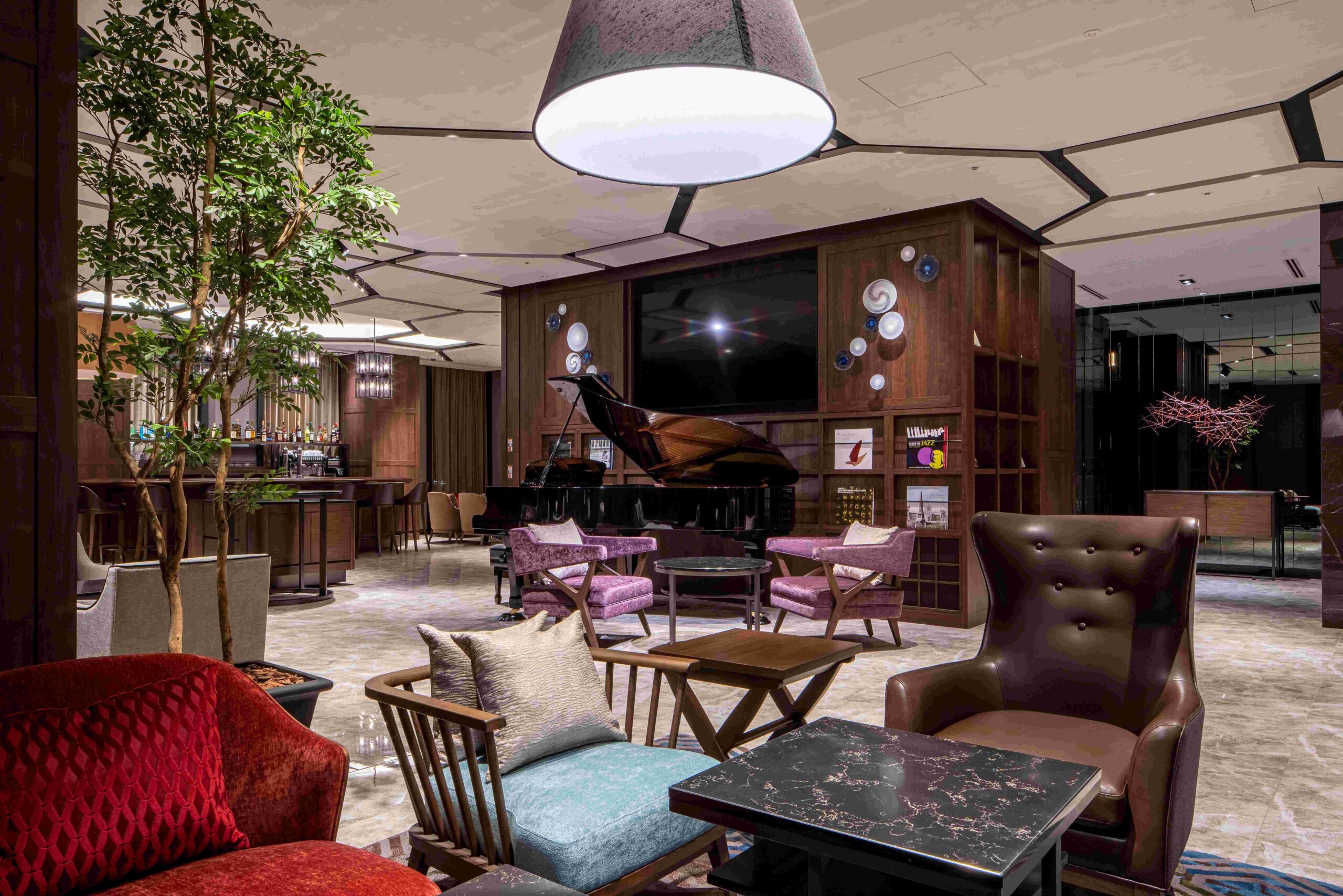
In fact, Mr. Yoshikawa was the performer for the very first salon concert held at Hotel GrandBach Tokyo Ginza. “It was during the COVID-19 pandemic, so I remember it well. The Ginza location and the hotel’s atmosphere were both wonderful. I performed John Cage’s ‘In a Landscape,’ and I recall how much the audience enjoyed it.”
I also asked for his impressions of the hotel. “At first, I was surprised because I couldn’t imagine a hotel based on the concept of J.S. Bach (laughs). Bach’s music is magnificent, but as I’ve been studying it extensively lately, my perspective has changed quite a bit. Generally, he is seen as a composer of church music with a reputation for being good for the spirit. While the atmosphere is lovely, I believe dining is a major element of the pleasure of staying at a hotel, so I thought the ‘Wellness Cuisine’ proposed by Hotel GrandBach is excellent. The bar is also very elegant. I look forward to them carefully crafting original cocktails. The hotel has a refined atmosphere and is very comfortable,” he said, also speaking about the bar he visits frequently.

He continued, also speaking about the salon concerts at the hotel. “I think hotels are not only for staying overnight, but also places to dine, places with shops where you can shop, and culture—those things are ultimately important. It is the same with listening to music, but enjoying delicious food,and the presence of art and music plays a major role in enriching people’s lives. And those salon concerts at the hotel are extremely appealing for guests,aren’t they.”
Sharing the same space, listening to what you love, and seeing what you love. I could not help but nod deeply at Mr. Yoshikawa’s words that time that brings bliss to the five senses enriches life more than anything. Going forward as well, as a professional musician, through concerts in various countries and at hotels and elsewhere, he will likely continue to further accumulate and refine his sensibilities.
■Interviewer & Writer:
Naoko Kubo | Wellness & Beauty Journalist / Phytotherapist / Aroma Designer / Ayurveda Life Counselor
CONTACT Instagram @naonaonaozou/
■Photography:
Tomohisa Ichiki